
Menu



In their lifetime, almost everyone will experience impaired vision or an eye condition that will require an eye service of some sort.
Vision loss is a global “epidemic” and although 90% of vision loss is preventable or treatable, it still affects over 1 billion people worldwide.
In developed countries, retinal diseases, including age-related macular degeneration (AMD) and diabetic retinopathy (DR) are the most common cause of irreversible blindness presenting a growing public health issue.


The current state of vision loss
current
Back to top



million
million
million
Around 29 million people are living with a vision-threatening form of diabetic retinopathy
Around 21 million people are living with diabetic macular edema, a leading cause of vision loss among working-age adults
Around 20 million people are living with neovascular AMD (nAMD), the leading cause of vision loss in people aged 60 and older
0
0
0
These conditions will impact even more people around the world as the number of people living with diabetes continues to rise and the global population ages
Diabetic macular edema

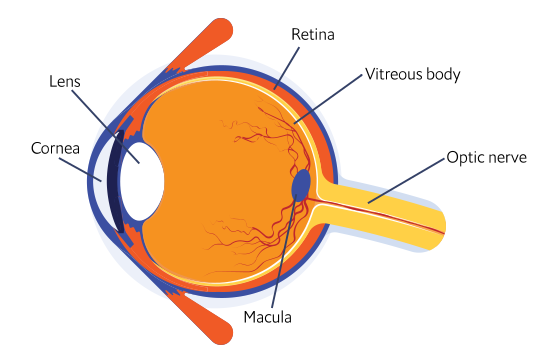
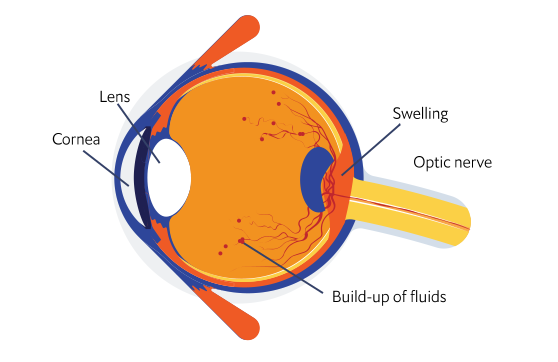
Normal eye
Diabetic macular edema
Diabetic retinopathy
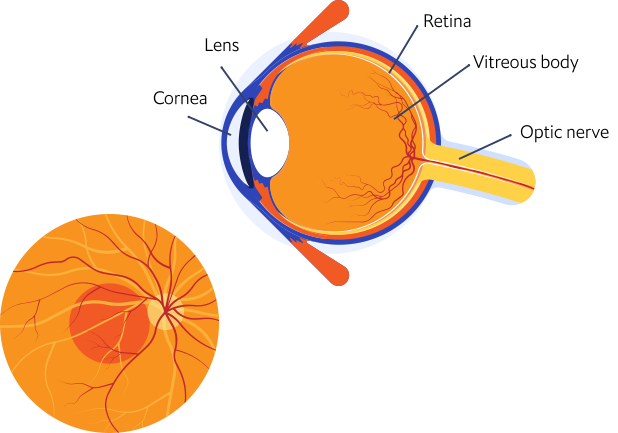
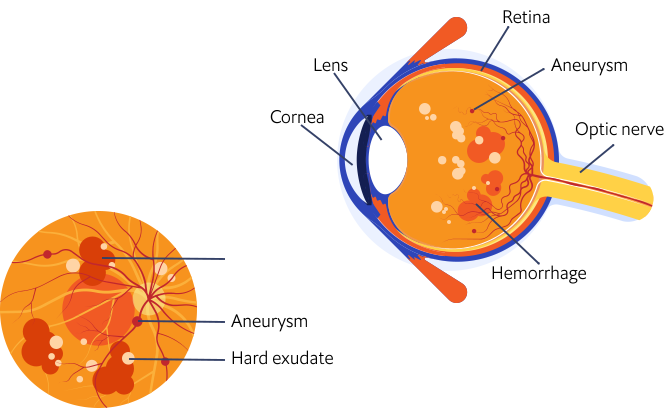
Normal eye
Diabetic retinopathy
Macular degeneration
Normal eye
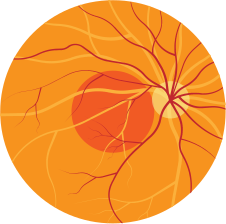
Clear vision
"Dry" macular degeneration
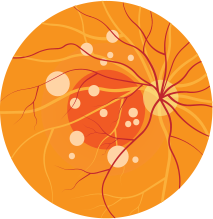
Unusually distorted vision
"Wet" macular degeneration
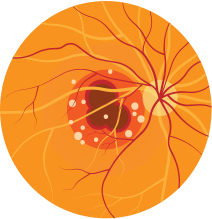
Blind spot in field of vision

burden
Global projected burden
Without new interventions the impact of vision loss will continue to rise, especially as the population ages.
By 2050, the Vision Loss Expert Group predicts the number of people experiencing vision loss will rise to 1.8bn, a 55% increase from 2020 estimates.
1.1 billion
1.8 billion
2020
2050
55% increase
The projected global prevalence of DR will rise from 103.12 million in 2020 to 160.50 million by 2045
Vision loss caused can have a devastating impact – physically, emotionally and economically – on patients, their families and caregivers and health systems at large
By 2050, the Vision Loss Expert Group predicts the number of people experiencing vision loss will rise to 1.8bn, a 64% increase from 2020 estimates.

1.1 billion
1.8 billion
2020
2050
64% increase
Over the next 25 years it is estimated that the global number of adults with DR will increase by 56%, to 161 million, with vision-threatening forms of DR set to reach 45 million
103 million
161 million
2020
2045
56% increase
Over the next 25 years it is estimated that the global number of adults with DR will increase by 56%, to 161 million, with vision-threatening forms of DR set to reach 45 million.

103 million
161 million
2020
2045
56% increase
The number of people with AMD is predicted to increase globally by almost 50% by 2040 to 288 million. In the EU, 77 million are expected to have AMD and by 2050, 22 million Americans will be diagnosed.
196 million
288 million
2020
2040
50% increase
The number of people with AMD is predicted to increase globally by almost 47% by 2040 to 288 million. In the EU, 77 million are expected to have AMD and by 2050, 22 million Americans will be diagnosed.

196 million
288 million
2020
2040
47% increase
Robert C. Layman, President, the American Optometric Association
In the US the number of 70, 80, 90, 100 year olds continues to increase profoundly. And vision loss in that population is considerably increasing.

8 million
13.9 million
2020
2050
“
“
Vision loss can have a devastating impact - physically, emotionally and economically - on patients, their families and caregivers and health systems at large.
Doug Earle, National President and CEO of Fighting Blindness Canada
If no policy decisions are changed … we project the number of Canadians living with a blinding eye disease will grow from 8 million to 13.9 million by 2050."
In 2018, it was estimated that vision impairment cost the global economy $410.7 billion in lost economic productivity. East Asia (China and North Korea) lost more than $90 billion in productivity. The US and Canada lost $55.5 billion. Europe, as a whole, lost more than $53 billion and Australasia lost more than $3 billion.

capacity
Health system capacity now and in the future
At this rate, ophthalmology capacity will be 42% of current levels by 2030.
Based on 2019 data, the growing prevalence of vision loss outpaces the growth rate of ophthalmologists in many countries, reflecting a significant gap in services.
Populations are ageing at a rate of 2.9% though the average compounded annual growth rate for ophthalmologists within these countries is only 1.8% based on Economist Impact projections.
If there is no change, the growth in ophthalmology capacity will not meet the future rising demand for eye services.
On average, there are 1.56 optometrists and 0.76 ophthalmologists per 100,000 people in high-income countries. This figure shows that some countries already fall below the Royal College of Ophthalmologists’ recommendation of 3-3.5 consultants per 100,000 population.
Doug Earle, National President and CEO of Fighting Blindness Canada
There is a capacity issue in the system. We don't have enough optometrists, we don't have enough ophthalmologists.
“
If there is no change, the growth in ophthalmology capacity will not meet the future rising demand for eye services.
Populations are ageing at a rate of 2.9% though the average compounded annual growth rate for ophthalmologists within these countries is only 1.8% based on Economist Impact projections.
Based on 2019 data, the growing prevalence of vision loss outpaces the growth rate of ophthalmologists in many countries, reflecting a significant gap in services.
At this rate, ophthalmology capacity will be 42% of current levels by 2030.
Jacinto Zulueta, Co-founder and President, Macula Retina Association, Spain
By the time a person may have access to therapy, it may take so long that the loss of vision that they have had during this interval is significant…we are talking a loss of years of healthy life because there has been no quick intervention.”
“
2019
2021

84%
In the UK, there has been an increase in wait times for cataract surgeries with a 84% increase from 2019-2021.
Covid-19 created delays in treatment that stretched an already overburdened system.

People in Canada are waiting an average of 34.1 weeks for initiation of ophthalmic procedures and those who waited more than 6 months for cataract surgery experienced more vision loss, reduced quality of life and increased rate of falls than patients with wait times less than 6 months.
Canada

UK
Even with the availability of ophthalmologists and optometrists, extended wait times and initiation of therapy can significantly impact the progression of vision-loss related conditions.
Anti-VEGF treatments that were delayed by at least 4 months resulted in significantly worse vision among people living with neovascular age-related macular degeneration.
impact
Health system impact
Expenditures related to vision loss
Patients who require fixed regimens of care (i.e. people with nAMD or DR), particularly injections, are faced with frequent visits to the doctors for regular treatments every 1-3 months. This can result in missed visits, leading to decreased injection frequency and a gradual decline in visual acuity over time as seen in the US and UK.
USD
$98.7 billion
CAD
$9.5 billion
AUD
$2.9 billion
focus
Areas of focus

Supporting innovation, research and development in drug therapies to ensure treatments are more effective, efficient, and longer-lasting
Support innovation, research and development
focus
Areas of focus
Supporting innovation, research and development in drug therapies to ensure treatments are more effective, efficient, and longer-lasting
Support innovation, research and development
Expanding the scope of practice for optometrists, primary care physicians and other allied health professionals to address capacity challenges
Address capacity challenges

Using a multi-faceted approach to increase awareness of vision loss and put a focus on prevention so patients are aware of their risks
Increase awareness of vision loss

Investing in technology and encouraging innovation to increase access, cost-effectiveness of treatments and productivity
Invest in technology

Advocating for more equitable access to care to resolve sociodemographic, gender and income barriers
Increase access to care
Expanding the scope of practice for optometrists, primary care physicians and other allied health professionals to address capacity challenges
Address capacity challenges
Using a multi-faceted approach to increase awareness of vision loss and put a focus on prevention so patients are aware of their risks
Increase awareness of vision loss
Investing in technology and encouraging innovation to increase access, cost-effectiveness of treatments and productivity
Invest in technology
Advocating for more equitable access to care to resolve sociodemographic, gender and income barriers
Increase access to care

Improving surveillance and data collection to better understand if policies and investments are leading to better outcomes.
Improve data collection
Improving surveillance and data collection to better understand if policies and investments are leading to better outcomes.
Improve data collection
References
1. Burton MJ, Ramke J, Marques AP, et al. The Lancet Global Health Commission on Global Eye Health: vision beyond 2020. The Lancet Global Health. 2021;9(4):e489-e551.
2. IAPB. Vision Atlas [Internet]. London: The International Agency for the Prevention of Blindness Available from: https://www.iapb.org/learn/vision-atlas/magnitude-and-projections/
3. Heier JS, et al. The Angiopoietin/Tie pathway in retinal vascular diseases: A review. Retina. 2021;41:1–19.
4. Liu E, et al. Diabetic macular oedema: clinical risk factors and emerging genetic influences. Clin Exp Optom. 2017;100:569–76
5. Wong WL, et al. Global prevalence of age-related macular degeneration and disease burden projection for 2020 and 2040: a systematic review and meta-analysis. Lancet Globe Health.2014;2:106–16.
6. Zhen Ling Teo, et al, Global Prevalence of Diabetic Retinopathy and Projection of Burden through 2045: Systematic Review and Meta-analysis, Ophthalmology, Volume 128, Issue 11,2021, Pages 1580-1591,https://doi.org/10.1016/j.ophtha.2021.04.027.
7. IAPB. Vision Atlas [Internet]. London: The International Agency for the Prevention of Blindness Available from: https://www.iapb.org/blog/mapping-the-global-optometry-workforce/
8. Burton MJ, Ramke J, Marques AP, et al. The Lancet Global Health Commission on Global Eye Health: vision beyond 2020. The Lancet Global Health. 2021;9(4):e489-e551.
9. The Lancet Global Health Vision: Vision loss could be treated in one billion people worldwide, unlocking human potential and accelerating global development. University of Michigan Health. February 17, 2021. Available at: https://www.uofmhealth.org/news/archive/202102/lancet-global-health-vision-loss-could-be-treated-one
10. European Council of Optometry and Optics. Blue Book 2020: Trends in optics and optometry - comparative European data. Available from: https://www.ecoo.info/wp-content/uploads/2020/10/ECOO-BlueBook-2020_website.pdf
11. Teo, Z. L., et al. (2021). "Global prevalence of diabetic retinopathy and projection of burden through 2045: systematic review and meta-analysis." Ophthalmology 128(11): 1580-1591.
11. Burton MJ, Ramke J, Marques AP, et al. The Lancet Global Health Commission on Global Eye Health: vision beyond 2020. The Lancet Global Health. 2021;9(4):e489-e551.
12. IAPB. Vision Atlas [Internet]. London: The International Agency for the Prevention of Blindness Available from: https://www.iapb.org/learn/vision-atlas/magnitude-and-projections/ .
13. Zhen Ling Teo, et al.Global Prevalence of Diabetic Retinopathy and Projection of Burden through 2045: Systematic Review and Meta-analysis, Ophthalmology, Volume 128, Issue 11, 2021, Pages 1580-1591, https://doi.org/10.1016/j.ophtha.2021.04.027.
14. Keenan, T. D., et al. (2021). Age-related macular degeneration: Epidemiology and clinical aspects. Age-related Macular Degeneration, Springer: 1-31.
15. Li JQ, Welchowski T, Schmid M. et. al. Prevalence and incidence of age-related macular degeneration in Europe: a systematic review and meta-analysis. Br J Ophthalmol. 2020 Aug;104(8):1077-1084. doi: 10.1136/bjophthalmol-2019-314422. Epub 2019 Nov 11. PMID: 31712255.
16. Bright Focus Foundation. Age-Related Macular Degeneration: Facts and Figures. July 13, 2021. Available from: https://www.brightfocus.org/macular/article/age-related-macular-facts-figures
17. Teo, Z. L., et al. (2021). "Global prevalence of diabetic retinopathy and projection of burden through 2045: systematic review and meta-analysis." Ophthalmology 128(11): 1580-1591.
18. Burton MJ, Ramke J, Marques AP, et al. The Lancet Global Health Commission on Global Eye Health: vision beyond 2020. The Lancet Global Health. 2021;9(4):e489-e551.
19. IAPB. Vision Atlas [Internet]. London: The International Agency for the Prevention of Blindness Available from: https://www.iapb.org/blog/mapping-the-global-optometry-workforce/
20. The Lancet Global Health Vision: Vision loss could be treated in one billion people worldwide, unlocking human potential and accelerating global development. University of Michigan Health. February 17, 2021. Available at: https://www.uofmhealth.org/news/archive/202102/lancet-global-health-vision-loss-could-be-treated-one
21. Response from The Royal College of Ophthalmologists (RCOphth) to the HEE Strategic Framework Call For Evidence. 6, September 2021. Available from: https://www.rcophth.ac.uk/wp-content/uploads/2021/12/RCOphth-response-to-HEE-Strategic-Framework-Call-for-Evidence-6-Sept-final-1.pdf
22. European Council of Optometry and Optics. Blue Book 2020: Trends in optics and optometry - comparative European data. Available from: https://www.ecoo.info/wp-content/uploads/2020/10/ECOO-BlueBook-2020_website.pdf
23. Al Ali A, Hallingham S, Buys YM. Workforce supply of eye care providers in Canada: optometrists, ophthalmologists, and subspecialty ophthalmologists. Can J Ophthalmol. 2015 Dec;50(6):422-8. doi: 10.1016/j.jcjo.2015.09.001. PMID: 26651300.
24. Al Ali A, Hallingham S, Buys YM. Workforce supply of eye care providers in Canada: optometrists, ophthalmologists, and subspecialty ophthalmologists. Can J Ophthalmol. 2015 Dec;50(6):422-8. doi: 10.1016/j.jcjo.2015.09.001. PMID: 26651300.
26. The China Study: Accessibility and affordability of cataract surgery has improved China - but there is still more to achieve. September 15, 2018. The Ophthalmologist. Available at: https://theophthalmologist.com/subspecialties/the-china-study#:~:text=To speak from the perspective,1.5 ophthalmologists per 50,000 people
27. IAPB. Vision Atlas [Internet]. London: The International Agency for the Prevention of Blindness Available from: https://www.iapb.org/learn/vision-atlas/magnitude-and-projections/ .
28. Global Burden of Disease Collaborative Network (2020). Global burden of disease study 2019 (GBD 2019) Results. I. o. H. M. a. E. (IHME). Seattle.
29. Resnikoff, S., et al. (2020). "Estimated number of ophthalmologists worldwide (International Council of Ophthalmology update): will we meet the needs?" British Journal of Ophthalmology 104(4): 588-592.
30. James H.B. et al. Delayed anti-VEGF injections during the COVID-19 pandemic and changes in visual acuity in patients with three common retinal diseases: A systematic review and meta-analysis, Survey of Ophthalmology, 2022
31. Martin, E. (2021). "Average cataract surgery wait time increases in NHS." from https://www.healio.com/news/ophthalmology/20211007/average-cataract-surgery-wait-time-increases-in-nhs.
32. Im JHB, Jin YP, et al. Delayed anti-VEGF injections during the COVID-19 pandemic and changes in visual acuity in patients with three common retinal diseases: A systematic review and meta-analysis. Surv Ophthalmol. 2022 Nov-Dec;67(6):1593-1602. doi: 10.1016/j.survophthal.2022.08.002. Epub 2022 Aug 13. PMID: 35970234; PMCID: PMC9374495.
33. Rein, D. B., et al. (2022). "The economic burden of vision loss and blindness in the United States." Ophthalmology 129(4): 369-378.
34. The cost of vision loss and blindness in Canada (2021). Canadian Council of the Blind. Available at: https://www.fightingblindness.ca/wp-content/uploads/2021/12/Deloitte-Cost-of-vision-loss-and-blindness-in-Canada-report-May-2021.pdf
35. Clear Focus: The Economic Impact of Vision Loss in Australia in 2009 (2010). Vision 2020 Australia. Available at: https://www.vision2020australia.org.au/wp-content/uploads/2019/06/v2020aus_report_clear_focus_overview_jun10.pdf
36. Khanani, A.M. et al. (2020) ‘SIERRA-AMD: A Retrospective, Real-World Evidence Study of Patients with Neovascular Age-Related Macular Degeneration in the United States’, Ophthalmology. Retina, 4(2), pp. 122–133.
37. Writing Committee for the UK Age-Related Macular Degeneration EMR Users Group (2014) ‘The neovascular age-related macular degeneration database: multicenter study of 92 976 ranibizumab injections: report 1: visual acuity’, Ophthalmology, 121(5), pp. 1092–1101
38. Khanani, A.M. et al. (2020) ‘SIERRA-AMD: A Retrospective, Real-World Evidence Study of Patients with Neovascular Age-Related Macular Degeneration in the United States’, Ophthalmology. Retina, 4(2), pp. 122–133.
39. Writing Committee for the UK Age-Related Macular Degeneration EMR Users Group (2014) ‘The neovascular age-related macular degeneration database: multicenter study of 92 976 ranibizumab injections: report 1: visual acuity’, Ophthalmology, 121(5), pp. 1092–1101
40. The Lancet Global Health Vision: Vision loss could be treated in one billion people worldwide, unlocking human potential and accelerating global development. University of Michigan Health. February 17, 2021. Available at: https://www.uofmhealth.org/news/archive/202102/lancet-global-health-vision-loss-could-be-treated-onev
Advocating for more equitable access to care to resolve sociodemographic, gender and income barriers
Increase access to care
Improving surveillance and data collection to better understand if policies and investments are leading to better outcomes.
Improve data collection