
Advertisement feature

The
AI-powered workforce

This image was created using generative AI tools

The
AI-powered workforce

How partnerships can deliver AI’s human promise

Automation anxiety has followed on the heels of each technological revolution, from the spinning jenny to the personal computer. It may have peaked with the current wave of artificial intelligence brought on by generative AI and large language models (LLMs). 

Whether AI automates or augments will determine the future for human workers. History offers cause for optimism. "There are parallels to the First Industrial Revolution in the conversations we're having now. We're in a similarly transformative period and the discussions – in civic, political, and commercial spheres – often have an existential quality," says Shaheen Sayed, CEO for Accenture UK, Ireland and Africa. “There’s always been a race between technology automating away and new jobs being created.” This is evident in today’s labour market that is full of roles that never existed half a century ago, from vloggers and app developers to solar farm managers.

Automation anxiety is running high since the advent of generative AI. Partnerships between business, academia and the public sector will be essential to ensure that AI augments and supports human workers.

Dress shirt, Furniture, Chair, Sleeve, Collar
Show transcript
“I think there’s optimism and the transition to working with AI. In that, as humans, we’ve dealt with these types of challenges before, you know, like I said, the industrial revolution, we’ve been through decades of reinvention of skills, and jobs.”

Shaheen Sayed
CEO
Accenture UK, Ireland & Africa

Jean Innes, CEO of the Alan Turing Institute, also takes comfort from history, debunking the simplistic narrative of machines replacing humans, but with one caveat: the pace of change. It took many decades for past technologies to diffuse through the economy, but AI is developing at unprecedented speed. “That is where employers, governments, institutions and individuals need to play their part,” warns Dr Innes. “If we don’t retain people’s trust in these technologies, we don’t realise the benefits.”

Ms Sayed believes that generative AI could address chronic economic and social challenges facing the UK and many other developed economies, including an ageing workforce and stagnant productivity. “While there's ongoing discourse about an ageing workforce and the difficulty of reskilling, I believe it is more nuanced than that. I think we'll see generational competency with this user-friendly technology.” AI could accelerate the development of apprentices and those without formal training or degrees. “If it’s taught well, you can do so much to access it in a way that feels meaningful to the labour market.”

Competencies once undervalued may enjoy renewed appreciation and increased demand. “The skills of empathy, educating, caregiving, are going to become more premium and valued in ways they aren’t today, but this is not a binary conversation about what people used to call soft versus hard skills,” predicts Ms Sayed.

Dr Innes, meanwhile, forecasts a demand for “translators” – those who understand enough about technology to engage with businesspeople, and vice versa. “These are the people who are excited about technology and can talk to somebody who isn’t as familiar about what it means and how to adapt. There will be a comparative advantage for this profile of person.”

“This technology is incredibly intuitive,” says Ms Sayed. “You hear talk about people being locked out of science, technology, engineering and mathematics (STEM) fields unless you have a degree in data science; this new world opens up opportunities for people who are interdisciplinary in terms of the way their mind works, that haven't been formally trained in code, for example, but have the aptitude to see problems differently.”

“

I think we’ll see generational competency with this user-friendly technology.”

Shaheen Sayed

CEO for Accenture UK, Ireland and Africa

The case for AI boosting rather than replacing the workforce is predicated on the creation of novel jobs and better work, and on a removal of the barriers that prevented many people from participating in the high-value technology sector. The user-friendliness of generative AI, in which natural language commands serve up an impressive array of tasks, from developing business plans to coding, has the potential to make everyone a techie. 

Ms Sayed, who comes from an arts background, quickly found herself leading technology projects for Accenture, including building early online payment and e-commerce systems. She believes that AI could unleash the creative potential of a wider pool of innovators that, whether through circumstances or luck, never had the opportunity to study computer science or coding.

Non-techies, rise

Flash photography, Light, Purple, Sky, Architecture, Electricity, Entertainment, Line, Violet, Fun

This image was created using generative AI tools

Owing to the pace of AI development alluded to by Dr Innes, there is an urgent need for cross-sector collaboration to maximise the beneficial outcomes and mitigate risks. To address anxiety among the workforce, for instance, employers should actively communicate their future skills outlook and invest in workforce transition. That is not currently the norm. According to Accenture research, 96% of workers in the UK want to learn new generative AI skills, but only 5% of organisations are reskilling at scale.

“Reskilling at pace is going to be a real competitive advantage for companies,” points out Ms Sayed. “We have just launched a whole new business division, LearnVantage, to help reskill and upskill our clients and their people across technology, data and AI.” Accenture will invest US$1bn over three years to help organisations become talent creators that can generate business advantage through learning.

“Plus, there’s a danger of hype and misunderstanding of these complex technologies.”

That creates a need for evidence-based tools and frameworks to guide decisions. Accenture and the Alan Turing Institute are developing a suite of applicable tools covering key areas including risk assessment and reskilling. One initiative, a simulator, makes AI business risk feel tangible for users to help them envisage future scenarios and provision for them ahead of time, drawing on Accenture’s responsible business framework and the Alan Turing Institute’s technical know-how.

The power of partnership

Business leaders, to be fair, are having to contend with a fast-moving technology with unknown risks and uncertain rewards, which may explain why many have yet to deploy a fully fledged AI transformation plan. “When you’re in the maelstrom of a busy job, running a business or organisation, there’s so much going on that it’s hard to step back and take a strategic view,” says Dr Innes.

“

Reskilling at pace is going to be a real competitive advantage for companies.”

Shaheen Sayed

CEO for Accenture UK, Ireland and Africa

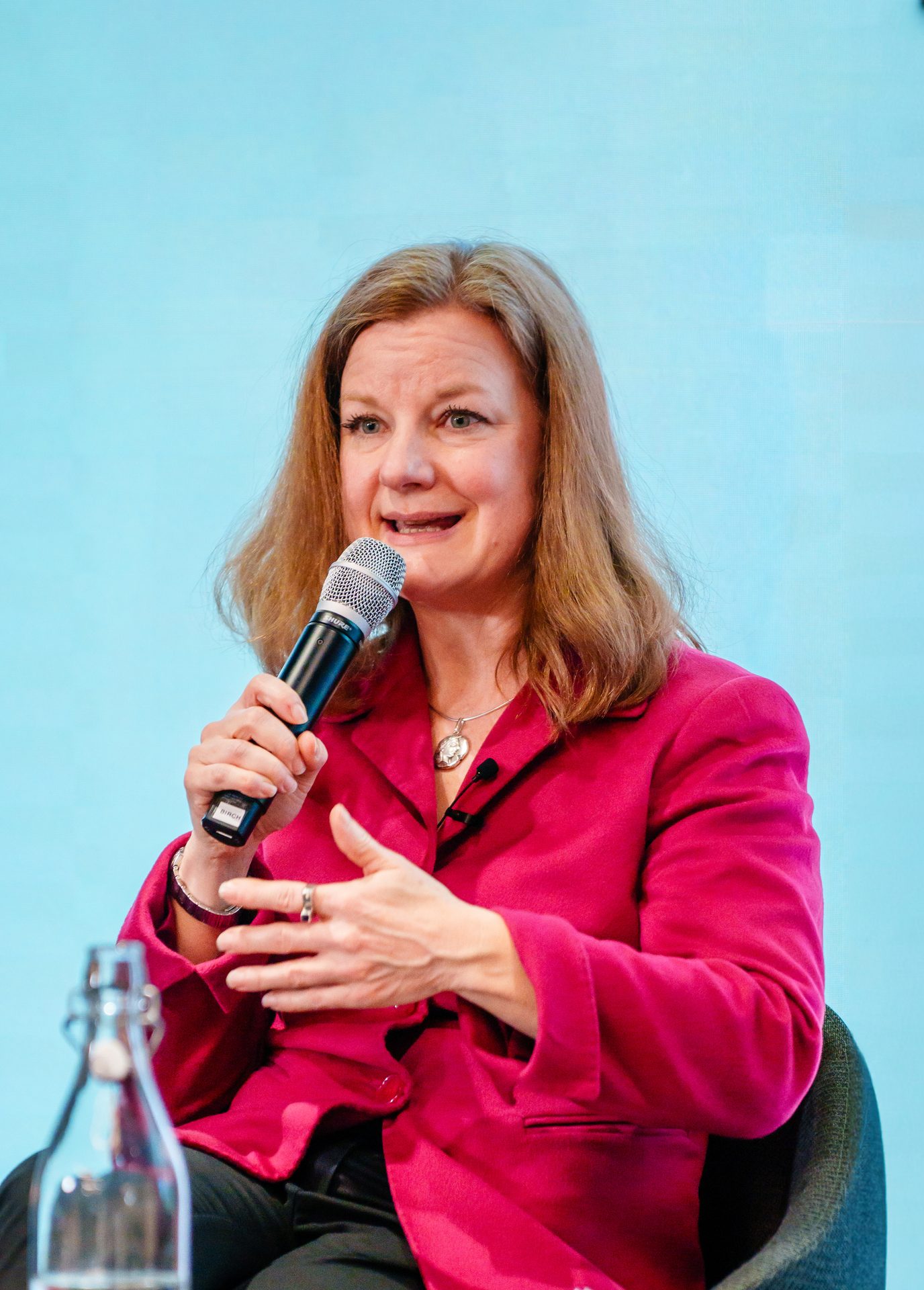
Audio equipment, Plastic bottle, Microphone, Lip, Gesture, Pink
Show transcript
“We’re working with a variety of partners on a program to upskill sectors in which these technologies have been less adopted, by which I mean agriculture and farming, creative industries. and transport and logistics, some very advanced users, some less so, and those sorts of sectors. And so this skills framework is in active use, you know, working with SMEs, others to really start people on the real journey of using these things.”

Dr Jean Innes
CEO
The Alan Turing Institute

For Dr Innes, AI risk needs to be communicated in a way that resonates, to avoid being overly theoretical or academic. She recalls a deepfake tool developed by her technical colleagues in the early days of synthetic media, featuring a politician announcing that the UK was going to war. “It sent a shiver down everyone’s spines and made viscerally clear the potential risks of deepfake audio and video, which we’re now seeing play out for real.”

Accenture and the Alan Turing Institute are also harnessing insights from the Data and AI Skills Taskforce, which they co-chair, supporting research to inform recommendations for practical actions that government and private organisations can take to address the rapidly approaching workforce challenges of widespread generative AI adoption. 

For Ms Sayed, today is a window of opportunity to forge partnerships that ensure this powerful new capability delivers tangible social and economic gains for all. “We are facing some of the world’s most wicked problems. We can use AI to collaborate and create partnerships that help address them at a pace unprecedented – this should be cause for great optimism.”