How do we build social capital in a hybrid workplace?

Advertisement Feature

As offices begin the process of re-opening, a new hybrid model of working is emerging, based on a mix of days in the office and remote working, with hot-desking as the new normal. Traditionally, social capital at work was built through incidental and accidental interactions in the office. This new way of working may jeopardise this, with new and younger employees finding it harder to build rapport with their colleagues.
Tell us your opinion in the live poll at the end.




How do we build social capital in a hybrid workplace?
As some countries and cities relax social distancing requirements, the new world of hybrid working is starting to take shape.
Pleased with the balance brought about by increased flexibility, most are happy not to return to the office full-time. According to Accenture, 83%
of people see a hybrid model, where they can work remotely 25-75% of the time, as optimal.1 However, the same research also suggests that
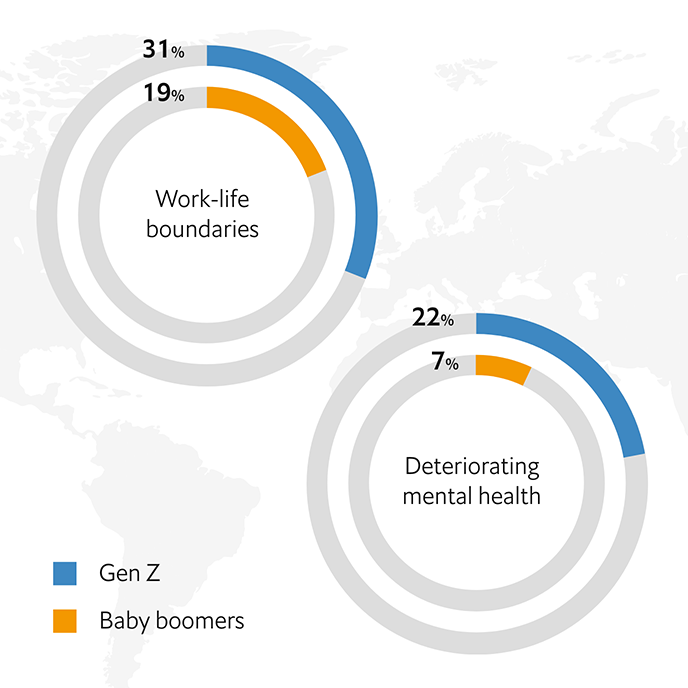
finding a model that works for everyone will be difficult. For example, three in four (74%) Gen Zers want more opportunities for face-to-face
collaboration, a higher percentage than Gen Xers (66%) and Baby Boomers (68%).
Although hybrid working offers benefits to both employers and
employees, it will raise challenges. This is especially relevant in terms of the relationships, skills and experience that on-site working can foster.
A May 2021 survey of 1,036 members of the UK’s Chartered Management Institute in office-based organisations found that managers expect remote working
to decrease access to career development opportunities.2 Fifty-five percent reported that it would decrease opportunities to develop workplace
networks; 38% said that it would decrease access to opportunities to represent the organisation at external events. While the majority of managers did
not think that remote working would limit access to training, development and promotion, a minority remain concerned: for example, 26% said that it would
decrease access to training and development; 23% said that it would decrease access to stretch projects; and 13% said that it would impact pay and
progression.
Partly, this is due to a paradoxical element of this new flexible way of working. When people are working remotely, communication
has to be planned, and it may be more difficult to develop relationships in an online environment that is unavoidably less natural.3 Pre-pandemic,
relationships were often nurtured in situations where we did not even realise it was happening—a greeting in the elevator, perhaps, or post-meeting
(and post-work) small talk. People build trust by spending time together. We form and sustain social bonds, expressing verbal and non-verbal communication
in ways that convey understanding, empathy and shared concern. In and out of work, this is how we nurture relationships—and endless Zoom calls cannot
replace it.4 Being more present is also good for an employee’s career trajectory, making them more visible to management and more eligible
for new projects or promotions.5 So how do firms approach hybrid working with all of this in mind?
Explore more
insightsExplore more insights



Social capital and its importance
The key concept for companies to consider is social capital. This is the combined value of people, their networks and their interactions. To what
extent do employees create and share positive interactions? How do they understand the values of others? Do they sense trust throughout the organisation?
All of these aspects contribute to social capital, which spans output, productivity and inclusivity, and even impacts our basic human needs by providing
a sense of belonging.6 Social capital is the value—in human rather than financial terms—that a firm gains from community, collaboration and
camaraderie.7
Social capital is as important to the careers of individuals as it is to organisations. Developing collaborative
relationships, enhancing your network and building a personal brand provides access to resources, support and knowledge, and facilitates new
opportunities.8 When someone counsels you out of a dead end without an obligation to; when someone offers expertise or time because they think
it might help—this is the personal value of social capital. Social capital is critical to a thriving workplace. It helps knowledge and information flow.
It energises our thinking. And it contributes to lower absenteeism, lower turnover, better organisational performance and increased
innovation.9
A workplace rich in social capital is evident by a team that communicates fluidly and collaborates extensively—something
that employees themselves have clearly recognised amid the pandemic. In a survey conducted by interior design firm Morgan Lovell of 1,000 office workers
in mid-December 2020—as the UK entered a brief pause between lockdowns—90% cited “social contact” as the thing they missed most about the office, while 47%
said that they missed “the ability to collaborate easily.”10
Social capital can be especially important to younger workers. At the start
of a career, people need role models and mentors. They need to be around people, to see how others behave, to overhear things, to be able to ask questions.
They need opportunities to observe and absorb, to see management and leadership in action. Remote working makes some of this harder.11
Indeed,
while experienced employees often have established professional networks and dedicated home offices, younger staff say the pandemic has left them under-informed
and cut off. There are growing concerns that they are missing out on career opportunities that older colleagues took for granted.12 Without chance
encounters, small talk over coffee and even routine contact such as team meetings, it is hard to feel connected, much less build meaningful
connections.13 All of this makes being a younger employee—or a new joiner—a more daunting proposition.


Nurturing social capital amid hybrid working
So how can the benefits of hybrid working be maintained while ensuring that social capital is built and strengthened? Firms must first acknowledge
that intangible assets like skills, knowledge and professional networks need to be addressed differently. The efforts of individuals to build and maintain networks,
and develop through informal and peer learning will now require more input than previously. Lunch meetings, a quick coffee together, random encounters at the
water dispenser; all will be less frequent. Individuals, bosses and team leaders will need to invest mindfully—otherwise, networks will
atrophy.14
Leaders will need to be proactive about encouraging people to build their networks. They can do this by connecting people across
departments, and creating time for people to have virtual coffee or networking discussions.15 Perhaps Slack can be used for informal connections and
conversations; a “Random Room” on Google Hangouts can allow anyone to drop in.16 Managers must receive encouragement (and be rewarded) for prioritising
the building of social capital.17 Employees must feel that they exist in, and can contribute to, a work culture where social support
thrives.
The existence of a positive social culture in the workplace has always involved a guiding hand. As hybrid working takes off, that guidance
may need to be a little stronger—and a little more intuitive.
What’s your
view?What’s your view?
Please vote on the two questions below to see how your view compares with your peers'
The world of work in
fluxThe world of work in flux