
From Zilch to $2bn

Back in 2018, Zilch was a tiny company with huge ambitions. Newly founded and with the aim of disrupting the
fast-growing “buy now, pay later” sector, its staff roster at the time consisted of just three people: CEO and founder
Philip Belamant, CIO Sean Hederman and COO Rakesh Harji. Recognising the company’s huge potential and need for top talent,
they moved in early 2019 to their current headquarters at
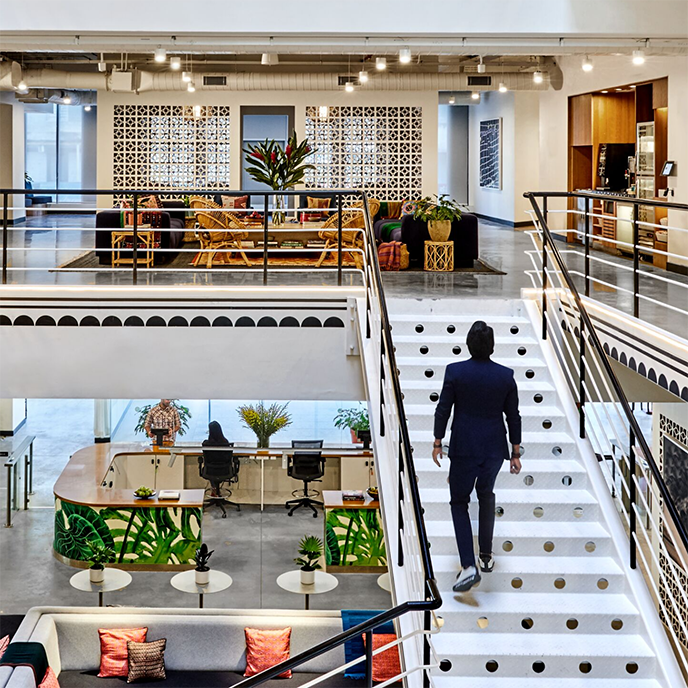
WeWork 123 Buckingham Palace Road in London – a strikingly modern building, near Victoria station, with well-connected
transport links and space to grow. “That’s when we started to hire,” says Mr Belamant.
The years that followed
have seen vertiginous growth for the company as a result of the runaway success of its model, which offers users a card
with a personalised credit line, zero interest and no hidden fees. Last October, following its latest funding round,
Zilch was valued at more than $2bn, setting a record as the fastest company in Europe to reach $1bn “unicorn” status.
Its customer base has mushroomed from zero to two million, and those three employees have now multiplied to more than 200.
Flexibility was a key factor in choosing WeWork as their workplace partner, says Mr Belamant: “You have an aspiration that
the business will do well, but you’re not sure when the inflection point will arrive and at what speed you’ll need to hire
or where you might need those team members. WeWork offered a very flexible set-up to begin with, and we grew from there.”
WeWork provides the option to scale workspace up and down as needed, meaning that companies no longer have to predict
headcount and company growth for ten or 20 years’ time, unlike traditional office leases.
Today, Zilch occupies
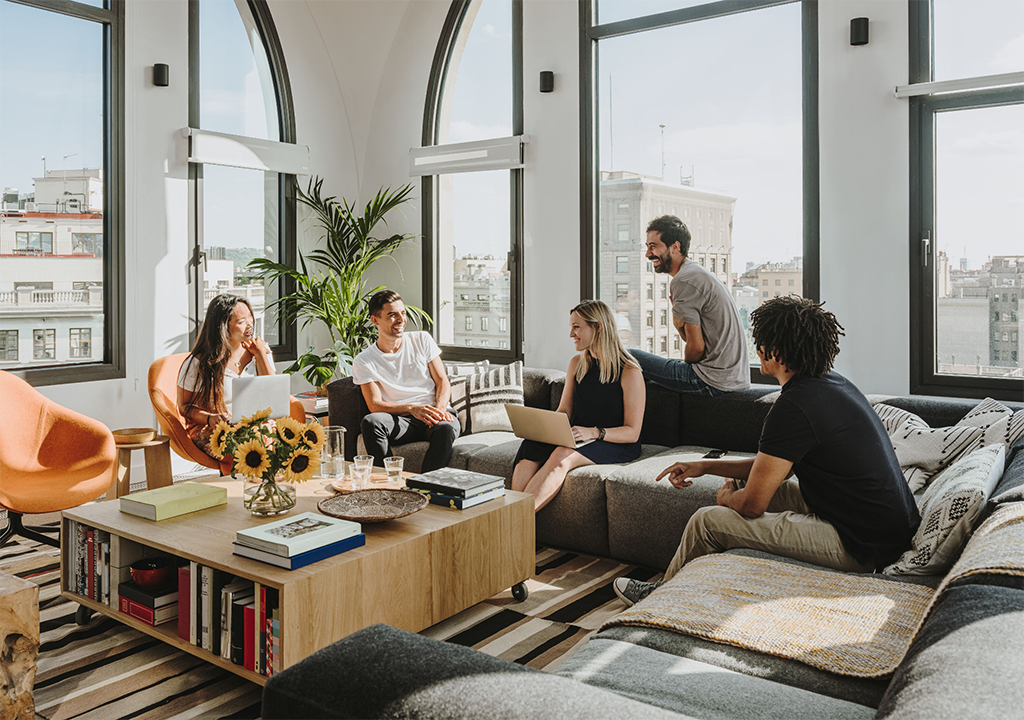
around half a floor at WeWork 123 Buckingham Palace Road. Its full floor office has been customised to feature Zilch's own
branding. The space features six meeting rooms of different sizes, breakout areas, a boardroom and a pantry area – all
designed for employees to connect and collaborate.
“The office is the central point of our business and our culture,” explains Mr Belamant. “We have a young team and we wanted to give them an environment that made them excited to come to the office and where visitors, such as investors and potential recruits, can feel the positive energy, come in and go, ‘Wow, this is nice!’. The space is beautiful, the location is phenomenal, and the service has been fantastic.”

You have an aspiration that the business will do well, but you’re not sure [...]. WeWork offered a very flexible set-up to begin with, and we grew from there.
Philip Belamant
CEO and founder of Zilch


Designing a hybrid, and equal, workplace
While navigating rapid growth, the company has also had to adapt to new ways of working as a result of the сovid-19
pandemic. When the UK’s work-from-home guidance was lifted last summer, Mr Belamant and his leadership team needed to
decide how best to combine the new-found flexibility employees were enjoying with the need to maintain and continue
building Zilch’s strong company culture.
“Especially for start-ups, building the culture of the business is
fundamental to succeeding and it's very hard to do that on Zoom,” he says.
The answer was hybrid working.
A global survey carried out last summer by Economist Impact on attitudes to work-life balance in a post-covid age found that
for almost half (46%) of business leaders, the need for flexibility dictated their company’s approach to the return to the
office. For Mr Belamant, this was certainly the case, but it was flexibility with a layer of structure, with Zilch employees
now working in the office on Mondays, Wednesdays and Thursdays, and working remotely (or their nearest WeWork) on Tuesdays
and Fridays.
Mr Belamant is aware that some companies offer employees a choice on which days they come to the
office, but he felt it was important that everybody should come in on the same days, as this negates the possibility
of
proximity bias, when those who are present are more likely to be involved in projects or gain promotion.
“We wanted to avoid situations where people can say, ‘I wasn’t there, so why did this decision get made?’” he says. “Our
view was, let's agree that when we're in, we get everybody in, so that we can all be aligned.”
The ability to
work both at home and in the office is a key driver of work-life balance, according to Economist Impact’s survey. However,
certain groups are likely to want to spend more time working from home. Given the choice, for example, parents with
young children will spend less time in the office.
“We discussed this extensively,” says Mr Belamant. “I don't
think you will ever solve it for everyone, but we actually have had feedback from our team saying, ‘You know what, this is
fantastic, because I can be around the home more days of each week than I am in the office,’ [...] which means that
employees with children may not need childcare full time.” Mr Belamant also notes that employees have the choice to switch
days in the office from time to time, as needed.
One of the primary concerns that workers have as they return
to the workplace, Economist Impact found, is safety in communal spaces and busy offices (25%). Mr Belamant says
the scalability that WeWork provides was a key factor in assuaging such worries. Zilch could extend its office space as
needed, allowing working areas to be better spaced out. Furthermore, WeWork implemented
health and safety measures across
its portfolio of buildings worldwide, which alleviated the work for Zilch management and reassured Zilch employees that
the necessary steps had been taken for their safety and comfort. These measures – which include enhanced air quality, more
frequent cleaning schedules and behavioural signage to help guide members through its space – were awarded
a Global Certificate of Conformity by Bureau Veritas, an internationally recognised testing, inspection and certification
organisation.
Who's getting it
right?Who's getting it right?
Scaling up, around the world
Zilch has global ambitions, and Mr Belamant believes WeWork, with its global footprint and well-designed, scalable office space, will play a crucial role in the company’s expansion. Last summer, the company established its first US office at WeWork Brickell City Centre in Miami, which will house 65 Zilch employees. This summer, Zilch plans to begin a pan-European roll-out, and so offices will be needed in continental Europe too.
We wanted to avoid situations where people can say, ‘I wasn’t there, so why did this decision get made? […] Our view was, let's agree that when we're in, we get everybody in, so that we can all be aligned and feed off of each other's energy.
Philip Belamant
CEO and founder of Zilch
“[With WeWork], everything works seamlessly for us,” says Mr Belamant. “We had our team over from the US two weeks
ago, and they could all use their [WeWork membership] cards to tap in, walk straight into our office here at 123 Buckingham
Palace Road, open their laptops and connect to the VPN that we've set up with WeWork worldwide. All of that stuff works well
for us.”
WeWork offers companies and individuals options to access hundreds of its locations globally.
WeWork OnDemand is a pay-as-you-go
service that allows individuals to book workspace and conference rooms, through their phones, by the hour or day – as
easily as you would book an Uber. Similarly,
WeWork All Access is a monthly subscription membership (like a gym membership) through which members have access
to 700+ WeWork locations globally to find a workspace that is most convenient and suitable for them.
In London,
Zilch has made use of the "hub-and-spoke" model since last summer, meaning that employees can choose to work from its HQ in
Victoria, or visit a WeWork location that is close to their home.
“We first did it when lockdown started to ease
and people could go back to the office at their discretion,” says Mr Belamant. “A few of the teams who live close together
would spend the day at their local WeWork because they wanted to get out of the house, and that worked very well for us at
that point. And now, on Tuesdays and Fridays, if employees have kids at home during term breaks and feel that they need
space where they can work quietly, they will actually go to a WeWork that's nearby.”
Mr Belamant’s advice for leaders
who are contemplating a hybrid work model is to decide what kind of culture they want to build and then have conversations
with their teams to understand their views and preferences. “Align those two things and make a decision,” he says. “And don’t
worry if you don’t get it 100% right the first time, because I don’t think anyone has.” That is the beauty of flexibility.
The world of work in
fluxThe world of work in flux